Review: Dorothy
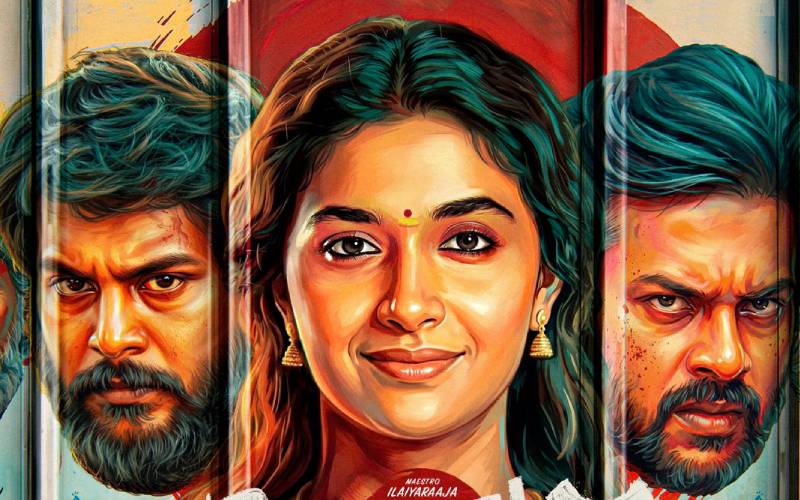
Film: Dorothy
Writer & Director: Karthik Subbaraj
Original Score: Maestro Ilaiyaraaja
Cast: Sananth, Rishikanth, Keerthy Suresh
Director of Photography: S Thirunavukkarasu
Rating: 2 stars
Dorothy is a technically accomplished film that unfortunately struggles because of the way its central ideas are presented. Director Karthik Subbaraj has clearly attempted to examine patriarchy, caste, masculinity, violence and social conditioning, but the film’s treatment of these themes can feel so one-sided that it risks reducing its male characters to convenient embodiments of everything wrong with society.
The film increasingly comes across as misandrist in its worldview, with masculinity repeatedly associated with aggression, brutality and cruelty. Rather than presenting a nuanced examination of masculinity as a social construct, the storytelling frequently makes it feel as though men themselves are the problem.
The result is a film that can be read as sexist from beginning to end, because its dramatic universe repeatedly places men on one side—as perpetrators, brutes or oppressors—and women and transgender characters on the other—as victims, sufferers or morally superior figures.
A film can—and should—question violence and caste-based power structures. But when virtually every male character is made to carry some variation of the same negative traits, the social critique starts losing its subtlety.
The film seems determined to establish that masculinity itself is something that needs to be overcome, rather than making a sharper distinction between masculinity and destructive behaviour.
One of the film’s most noticeable devices is its repeated use of the phrase “Aambala Thimir” (male arrogance). Its recurrence raises an obvious question about the film’s censoring and certification: how did the repeated use of such an explicitly gendered expression pass without becoming an issue?
Criticism of arrogance is perfectly legitimate but assigning this trait to only the male gender is not.
The film’s treatment of transgender characters also invites scrutiny. At points, the narrative appears to position a transgender character as more compassionate, mature or emotionally evolved than the men around her. There is nothing objectionable about portraying a transgender character positively; the problem is the contrast the screenplay constructs, where such positive characterization can seem designed to reinforce the film’s negative characterization of men.
The issue, therefore, is not the transgender identity of the character but the simplistic gendered contrast created by the writing.
Take for instance a sequence which involves a transgender character who, of her own accord, repeatedly troubles two men who are grieving the death of a woman they knew. When one of the grieving men finally responds angrily to her solicitation, the scene appears to frame the man’s reaction as evidence of his brutality while presenting the transgender character primarily as the victim. This is precisely the kind of scene where a more balanced screenplay could have acknowledged the behaviour and emotions of everyone involved instead of seemingly assigning moral innocence to one side and culpability to the other.
Yet, for all these reservations about the writing and its ideological framing, the performances of Sananth and Rishikanth are exceptional. Both actors bring tremendous conviction to their roles and manage to give emotional depth to characters whom the screenplay sometimes seems intent on reducing to symbols.
Ilaiyaraaja’s background score is another major strength. His score gives the film a haunting and expansive quality and remains one of its most impressive technical achievements. S. Thirunavukkarasu’s cinematography is outstanding. The visuals give the film a distinctive mood and sense of place and are a treat to watch. The film’s technical craftsmanship is difficult to fault; its visual language and soundscape are considerably more accomplished than the writing that connects them.
That ultimately becomes the biggest disappointment of Dorothy. The film looks and sounds far better than it is written. Sananth and Rishikanth deliver superb performances, Ilaiyaraaja provides an evocative score, and Thirunavukkarasu creates striking imagery. But the narrative repeatedly pushes its characters into predetermined categories: men are made to look like villains or brutes, while women and transgender characters are predominantly positioned as victims or morally enlightened figures.
A more nuanced film could have explored victimhood, privilege, gender and violence while allowing every character—including its male characters—the complexity to be simultaneously flawed, sympathetic and human.